




ZIG-ZAG MASTERY
An Elliott Wave Master Class Event!
In March 2021, I'll be presenting Zig-Zag Mastery!... I consider this to be THE most valuable Elliott Wave Trading Class that I’ve ever put together… and by the way, as a Subscriber, you can attend for free!
So what is a ZIG-ZAG?… for those not familiar, it’s an Elliott Wave “Corrective” pattern that literally looks like a “Zig-Zag”. These patterns appear very commonly and if you know how to verify the trading setup, they can be a very reliable trading signal.
Having learned the rules for trading Zig-Zag patterns, we’ll use real trade examples from our recent Trade Alerts to apply this strategy in action in the real world. In this session we'll use Impulse Wave 4 patterns to identify a starting point for Zig-Zag trading setups.
Learn directly from pro-trader Rob Roy. You'll receive detailed instruction on the specific methods that Rob uses to select trades for Subscribers!
Tomorrow, you could begin doubling your account every single month starting with one letter.
The letter will come from a 20-year trading professional named Ian Cooper. He says, “In 2017, following my trades you would be doubling even tripling your account some months. Let me show you how.”
He will show you exactly what to do... and he’ll give you the blueprint for just $1.
The short answer is simple – when it is ready to go up. The longer answer requires a bit more explanation. To begin our discussion, let's concentrate on the buy side of the equation as opposed to short selling. There's a place for short selling in the market, but when you are concentrating on low-priced shares, as we are here, you are better off sticking with the long side of the market.
Share prices, for a variety of reasons, frequently get out-of-favor and beaten-down. Just as the 80-to-one shot in a Maiden race doesn't understand the long odds against him, companies, with few exceptions, don't undertake their day-to-day operations with an eye on the share price. Apart from suddenly producing surprising results, there is little a company can do to promote higher share prices other than to run their best race. As a result, companies frequently get what is called, "technically oversold." This means that the bias in the market, for a multitude of reasons, is to undervalue of the company's shares.
We don't need to go into the many reasons why a company might be technically oversold. Bad earnings, a bear market, management shenanigans, an incompetent Conference Call presentation, lawsuits – the reasons go on and on. The point is, the company's shares are taking a beating, and there is an underlying golden opportunity for astute investors to take advantage of the situation. I know what you are thinking… okay, tell me how!
The first step is to develop a built-in radar detector for technical "breakdowns" in the market. Has a long-standing trend line been broken? The price action will trigger stops. Share prices should start to decline and trend lower. Bearish sentiment will build. At this stage, the mounting hopelessness of the situation is sowing the seeds of the next bull market in the stock. But there are few observers of this fact since the sellers are busy jumping ship. In the rush to the exits, the downward momentum builds. In due time – it could be weeks, it could be months – the last seller sells. At this point, you must remember that market breaks are never accomplished in a vacuum. For every share sold, there is a share purchased. It may not occur in a one-to-one fashion, however. One-hundred sellers may sell in a panic to a single well-financed buyer. The number of shareholders may have decreased, but the number of shares most assuredly has not. I have a friend who routinely begins his buying campaigns by acquiring a couple of million shares in a company. Do you think he finds three or four sellers to sell him those shares? No. He buys 10,000 here, 5,000 there – and over a period of weeks or months, he acquires his position.
At the bottom, a stock may have been languishing. But, more often than not, the bottom is formed in a series of panicked, distressed selling campaigns punctuated by an occasional price spike. This kind of price action is not easy on the nerves for either buyer or seller. The bear juggernaut will not give up the ghost readily. Even temporary rallies will initially be met by massive selling. But in the end, the support will hold and the stock will rise. When the downturn is fully put to rest, the technical indicators immediately become positive. This is the sign that the trend has changed. The fundamentals will be next to fall into line.
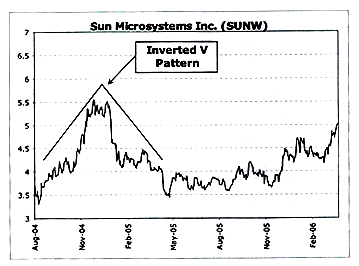
For example, consider the situation in Sun Microsystems, Inc. (SUNW), a once darling of the Street that had fallen out of favor. The stock then made a round-trip from $3.50 to $5.50 in 12 months. In completing its pattern, the stock's chart finished the inverted-V pattern. Trading just above the support, Sun Microsystems was ready to move higher once again.
Was the stock oversold at $3.50 a share after topping at $5.50? You bet. A number of technical indicators, pointed toward an oversold condition. The problem is, no one wants to catch a "falling knife." It will take time for Sun's shares to regain the enthusiastic support of the investor community.
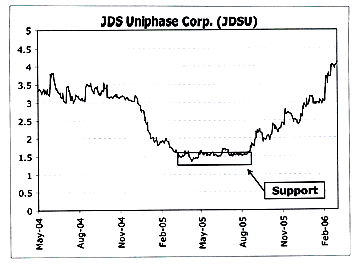
Some stocks culminate their bear markets in what are known as “selling climaxes”. JDS Uniphase had such a one day selling climax when it fell to its 52-week low at $1.32 a share. The stock closed near the high end of its range on the day, a sign that the downward move was over. Then it traded higher to cover $1.75 a share and was then trading at $4.11. The selling climax marked the end of a prolonged and persistent decline that extended all the way down from over $5.
Can one say that the selling climax pinpointed the end of the bear market in JDSU’s shares? Although nothing is ever certain, it is likely that the long nightmare was finally over for the company’s shareholders. The stock had enjoying exceptional volume in weeks to follow.
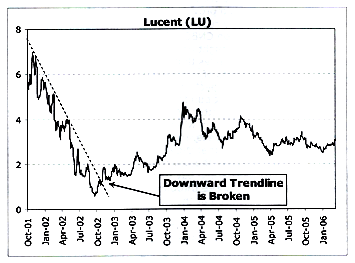
Even a casual glance at the Lucent Technologies, Inc. (LU) chart below will demonstrate how clearly the downward trend-line was broken in months as that troubled company began to trend higher. When you have a company like Lucent, you have a lot of unhappy of investors. In years prior, the company traded over $80 per share prior to its plunge to the bottom where it found support in the $1 - $2 range. Any rally in a stock like this is apt to bring out sellers who would rather have “something” rather than “nothing”. Nevertheless, the company’s shares had some bullish bias after the final selling climax finally occurred.
A basic tenet of technical analysis is that you let the stock’s price action do the talking. Technicians are quick to ignore fundamental factors because they believe the stocks’ entire story is tied up in one simple statistic – the market price. The price is where both buyers and sellers have come into agreement about a particular stock’s intrinsic value. The buyers are willing to purchase at that price and the sellers are willing to sell at that price.
Now that you have established equilibrium price, where both buyers and sellers are in agreement, you need a counter-force to enter into the market to move the price either higher or lower. There are no shortages of factors that could provide this counter-force. You might have an analyst put out a buy recommendation on the stock. Or the company CEO might appear on CNBC. The fed could lower rates and the stock market as a whole might enjoy several days of higher prices. There’s a saying in financial circles that says – “the market is always right”. That means, regardless of one’s expectations, dreams, and hopes, you must ultimately respect the valuation that the market places on a stock. While Street pundits can easily talk up a stock’s prospects, the market knows better.
Remember, as a would-be technician, you want to let the stock’s technical status tell you where the shares are headed. In looking at a chart patter, ask where is the stock going? Stocks that bottom are often forming a base, which can be a highly bullish sign. A stock can be down and not out. Let the crowd purchase the glamour stocks. The real profits are to be made among those shares that are down and not out.
PLEASE READ: Auto-trading, or any broker or advisor-directed type of trading, is not supported or endorsed by TradeWins. For additional information on auto-trading, you may visit the SEC’s website: All About Auto-Trading, TradeWins does not recommend or refer subscribers to broker-dealers. You should perform your own due diligence with respect to satisfactory broker-dealers and whether to open a brokerage account. You should always consult with your own professional advisers regarding equities and options on equities trading.
1) The information provided by the newsletters, trading, training and educational products related to various markets (collectively referred to as the “Services”) is not customized or personalized to any particular risk profile or tolerance. Nor is the information published by TradeWins Publishing (“TradeWins”) a customized or personalized recommendation to buy, sell, hold, or invest in particular financial products. The Services are intended to supplement your own research and analysis.
2) TradeWins’ Services are not a solicitation or offer to buy or sell any financial products, and the Services are not intended to provide money management advice or services.
3) Past performance is not necessarily indicative of future results. Trading and investing involve substantial risk. Trading on margin carries a high level of risk, and may not be suitable for all investors. Other than the refund policy detailed elsewhere, TradeWins does not make any guarantee or other promise as to any results that may be obtained from using the Services. No person subscribing for the Services (“Subscriber”) should make any investment decision without first consulting his or her own personal financial adviser, broker or consultant. TradeWins disclaims any and all liability in the event anything contained in the Services proves to be inaccurate, incomplete or unreliable, or results in any investment or other loss by a Subscriber.
4) You should trade or invest only “risk capital” – money you can afford to lose. Trading stocks and stock options involves high risk and you can lose the entire principal amount invested or more.
5) All investments carry risk and all trading decisions made by a person remain the responsibility of that person. There is no guarantee that systems, indicators, or trading signals will result in profits or that they will not produce losses. Subscribers should fully understand all risks associated with any kind of trading or investing before engaging in such activities.
6) Some profit examples are based on hypothetical or simulated trading. This means the trades are not actual trades and instead are hypothetical trades based on real market prices at the time the recommendation is disseminated. No actual money is invested, nor are any trades executed. Hypothetical or simulated performance is not necessarily indicative of future results. Hypothetical performance results have many inherent limitations, some of which are described below. Also, the hypothetical results do not include the costs of subscriptions, commissions, or other fees. Because the trades underlying these examples have not actually been executed, the results may understate or overstate the impact of certain market factors, such as lack of liquidity. Simulated trading services in general are also designed with the benefit of hindsight, which may not be relevant to actual trading. In addition, hypothetical trading does not involve financial risk, and no hypothetical trading record can completely account for the impact of financial risk of actual trading. TradeWins makes no representations or warranties that any account will or is likely to achieve profits similar to those shown.
7) No representation is being made that you will achieve profits or the same results as any person providing testimonial. No representation is being made that any person providing a testimonial is likely to continue to experience profitable trading after the date on which the testimonial was provided, and in fact the person providing the testimonial may have experienced losses.
8) The author experiences are not typical. The author is an experienced investor and your results will vary depending on risk tolerance, amount of risk capital utilized, size of trading position and other factors. Certain Subscribers may modify the author methods, or modify or ignore the rules or risk parameters, and any such actions are taken entirely at the Subscriber’s own election and for the Subscriber’s own risk.