



Market swings can test even the most patient investors.
It’s tempting to react to sharp price movements, but for those with a focus on income, volatility doesn’t have to be a cause for panic. Instead, for peace of mind, you can jump into trustworthy ETFs that have a history of strength, and consistently pay out dividends.
Dividend ETFs provide exposure to baskets of companies with strong histories of paying and growing shareholder payouts. Many of these businesses are mature, financially stable firms capable of generating consistent cash flow even during economic slowdowns. For investors seeking income and reduced stress during uncertain markets, dividend ETFs can play an important role in a diversified portfolio.
Here are three to consider.
SPDR S&P Dividend ETF
The SPDR S&P Dividend ETF (SYM: SDY) invests in companies that have increased dividends for at least 20 consecutive years. With an expense ratio of 0.35%, the SDY ETF yields about 2.46% and gives investors access to some of the market’s most reliable dividend payers.
These companies have maintained their dividends through events like the dot-com crash, the financial crisis, and the COVID-19 pandemic. In fact, some of its top holdings include Verizon, Realty Income, Target, Chevron, Kimberly Clark, and Exxon Mobil.
Invesco S&P 500 High Dividend Low Volatility ETF
With an expense ratio of 0.30%, the Invesco S&P 500 High Dividend Low Volatility ETF (SYM: SPHD) targets both high dividends and low volatility, offering a 4.66% yield. For retirees or anyone relying on dividend income to cover living expenses, monthly payouts make budgeting much simpler.
One of SPHD’s most attractive features is its monthly dividend payout schedule. For retirees or income-focused investors, monthly payments can make money flow much easier.
There are two types of option contracts: "Calls" and "Puts". The buyer of a call option has the right, but not the obligation, to buy a specific stock at a set price (called the "strike price") anytime on or before the contract’s expiration date. The buyer of a put option has the right, but not the obligation, to sell the underlying stock at a set price anytime before the expiration date.
Combinations of options (calls and puts) let you benefit from big moves in the market, even if you don’t know if these moves will be up or down.
Buying a Call Option
The buyer of a call option has the right, but not the obligation, to buy a specific stock at a set price, the strike price, anytime on or before the contract’s expiration date.
One option contract controls a block of 100 shares of a stock. Contracts have an expiration date, and if the contract is to be exercised, it must be done before it expires. Expiration dates are always the third Friday of the month (technically, they expire on Saturday, but trading ends on Friday). Each option has a "strike price", a pre-determined set price for which the underlying stock can either be bought or sold.
When you buy an option, the price you must pay is called the "premium". Similarly, when you sell an option, you receive a premium. As do stocks on the NASDAQ Exchange, there is a "bid" and an "ask" price. When you buy a stock you pay the ask price; when you sell a stock, you receive the bid price. It’s the same with options.
A Straightforward Approach to Trading Weekly Options
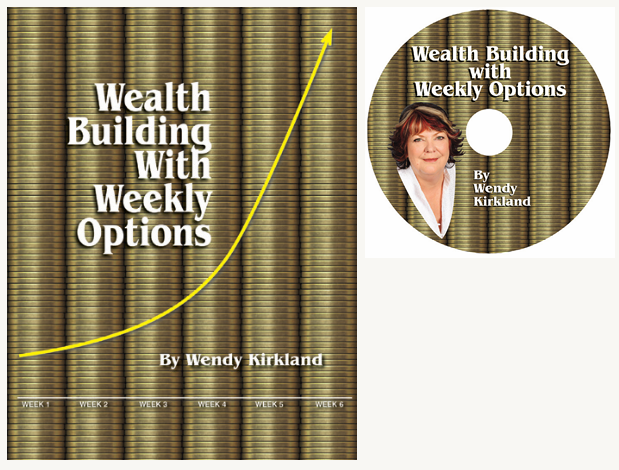
As stated in the Wealth Building with Weekly Options book, the strategy depends on locating liquid, high dollar, fast moving stock candidates. In addition, it is important to be aware of the overall market environment.
The content of this newsletter endeavors to support you and those strategy goals. The newsletter comes out on Wednesday evenings since Thursday is the day of new weekly option listings.
This week: Key indexes illustrated how bulls have been throttling bears lately as they marked
new highs on Wednesday. But the stock market action also reminded us about one
duty on the farm: a time to separate the wheat from the chaff.
For more than two decades, earnings season has become the season of heightened
volatility among individual growth stocks. Value stocks also might move at a higher
tempo. Yet volatility can be good. It can force investors to truly focus on the true
breadwinners of the portfolio, while sending those investments that grow moldy or
go sour into the trash bucket.
The "Double System" Trading Strategy for Bull & Bear Markets
Free Live Training with Ian Cooper
Tuesday, May 19th at 1:00 PM ET
Quick question:
What if you could trade with the confidence of having TWO strategic trading systems working together - one hunting AI-powered setups, the other generating consistent income opportunities?
That’s exactly what Professional Trader Ian Cooper has been doing since 1999.
Here’s what you’ll see:
- Recent real trades and results.
- How the AI identifies opportunities faster than manual analysis.
- Why combining Algo AI + Freedom Paycheck smooths out returns.
- A special offer (webinar attendees only) Purchase Algo AI and get Freedom Paycheck 100% FREE.
The webinar is FREE. Do not miss this incredible opportunity. Ian’s strategy works in both bull and bear markets.
NOTICE: Auto-trading, or any broker or advisor-directed type of trading, is not supported or endorsed by TradeWins Publishing (“TradeWins”). The information provided by TradeWins in its various materials, including trading recommendations, newsletters and educational publications is not customized or personalized for any particular person or risk profile. Past results are not necessarily indicative of future results. Results presented can vary and may not be typical for all subscribers. There are substantial risks involved with investing in the stock and options market, including the risk of total loss. You should only trade or invest "risk capital" - funds you can afford to lose.